Anatomy of a Russian Chemical Weapons Lie
If Moscow wants its Syrian allies to skirt the blame for chemical attacks, it is going to have to come up with some better evidence than a few beakers in a dingy basement.

Photo Illustration by Lyne Lucien/The Daily Beast
Russia and Syria say the alleged chemical weapons attack in Douma, Syria, was all rebel-staged fake—and promise that they’ve got the evidence to prove it. But one of the pieces of evidence they say shows a secret rebel chemical weapons lab shows nothing of the sort, experts say.
At the center of the claim is a building in Al-Shifuniya, in East Ghouta where the Syrian military says it found “a chemical warehouse used to manufacture chemical weapons against the Syrian Army” and a “research lab for experiments” run by the Islamist militant group Jaish al Islam in mid-March. The allegation tracked with an uptick in Russian claims about a rebel chemical weapons “false flag” in the making shortly after the Trump administration was considering military options to respond to the Assad regime’s alleged use of chlorine gas in early 2018—including an alleged February 25 chlorine attack on Al-Shifuniya itself.
Since Syrian state TV ran videos of the facility, Russia’s state-backed media outlet RT has amplified the story, calling the Al-Shifuniya site “a well-equipped chemical laboratory run by Saudi-backed Islamist terrorists” and the left-leaning Salon columnist Patrick Lawrence has cited the piece approvingly.
Russia’s defense ministry even seized on the facility and included it as evidence in a briefing denying Russian complicity in the poisoning of Russian double agent Sergei Skripal—without directly tying the lab to the attack in Salisbury, England. “After liberating an array of local communities in Eastern Ghouta, Syrian government forces located a clandestine workshop for the production of chemical munitions,” a Russian defense ministry slide with pictures of the facility reads. “[It is clear] that the workshop for chemical munitions is for provocational measures, as with previous impositions of guilt on Syrian government forces for employing chemical weapons.”

Shown by the Russian MOD during the March briefing.
Handout
Was in #EastGhouta today, 25 meters from a battlefront btwn Shifouniyeh & Misraba, areas recently liberated from militants. Western journalists flock to humanitarian corridor in north, but not a single one visited this makeshift chemical lab discovered by the SAA yesterday. pic.twitter.com/EdR0oNqBe0
— Sharmine Narwani (@snarwani) March 13, 2018
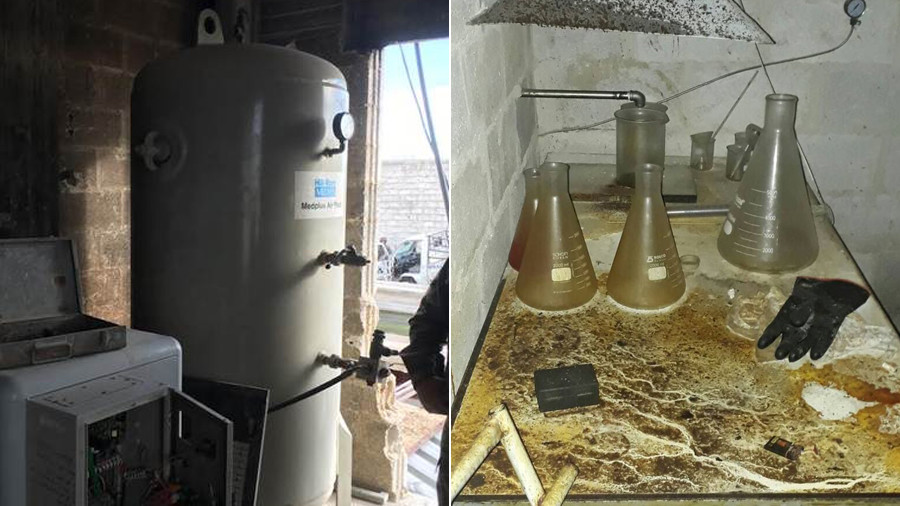
Videos of the Al-Shifuniya facility show fliers with the logo of Jaish al-Islam, one of the Islamist militant groups that held control of the the northeast Damascus suburbs. The videos also show equipment seemingly from commercial companies, like an air plant marked as the product of Hill-Rom, a medical device maker, a large metal container with a “Flainox” label, the name a fabric dyeing equipment firm, as well as several boiler-like metal containers in the basement.
Experts say it’s not clear what the facility in question was used for, but they are convinced that it couldn’t have been used to produce either the chlorine gas or sarin nerve agent that many believe were used in the fatal attack in Douma which prompted the U.S., France, and the U.K. to strike Syria on Friday.
Get the best of The Beast delivered right to your inbox
By clicking “SUBSCRIBE” you agree to our Terms of Use and Privacy Policy.
Asked if the equipment in the videos of Al-Shifuniya could be used to produce chlorine gas, Cheryl Rofer, a retired chemist with experience working on chemical weapons and environmental issues at Los Alamos National Laboratory, said “no.”
Chlorine is typically produced with electrolysis cells using either large amounts of salt or hydrochloric acid as feedstock and lots of electricity to produce and recover the gas.
“Chlorine is a gas at room temperature and pressure,” explains Clyde Davies, a former research chemist. “Its ‘critical point,’ below which it can be liquefied, is about 144 C, but it needs high pressure to do this, which is why it is stored and shipped in gas cylinders. Just like the ones that were dropped on Douma.”
The process can be dangerous and requires special equipment, according to the UN Joint Investigative Mechanism. “In the light of its corrosive and toxic nature, expertise and specialized equipment are required for its safe handling. For example, to transfer chlorine from a 1 ton container to smaller containers, a specialized filling station is required.”

Air plant shown by Syrian TV.
Syrian Arab News Agency or SANA
And this facility isn’t anywhere near “the scale needed for the attacks that have been observed,” Rofer wrote in an email. “All of the equipment, except for the boilers, is at laboratory scale. But the more fundamental problem is that none of the equipment is what is needed to produce chlorine and compress it into the cylinders that [investigative journalism outlet] Bellingcat has documented” in Douma.
Nor could the facility be used to produce nerve agents. “For sarin production, all of this would have to be much more contained than it is,” Rofer writes. The ramshackle construction in the facility would’ve put anyone nearby at high risk of exposure, which can cause harm at very low concentrations. “The housekeeping is terrible,” she adds. “When you’re working with chemicals, housekeeping is more than aesthetic; it’s necessary to avoid injuring yourself. If the setup in the [picture of glassware published by RT] was used to manufacture sarin, the operators are dead.”

Equipment marked as ‘Flainox.’
Ruptly
Syrian military personnel also pointed to presence of allegedly Saudi chemistry textbooks and a poster as evidence of a foreign hand in the purported chemical weapons facility. As a Syrian military officer points out in the video, a poster with a list of chemicals on it bears the title “The reality and horizon of the Saudi Chemical Industry.” It’s unclear where the poster comes from or what it depicts, but it shares the name of a report on Saudi Arabia’s chemical industry produced by the Saudi Consulting House.
The Al-Shifuniya facility also showed some limited evidence of conventional homemade explosives (HME) production. Items listed on a whiteboard in videos of the facility include perchlorate, aluminum powder, nitrocellulose—chemicals normally associated with HME and rocket propellant—as well as “PETN,” an acronym for pentaerythritol tetranitrate, a common HME in militant improvised explosive devices (IEDs).
“These are used to prepare explosives,” a Syrian officer explained in the video, claiming the explosives are mixed with chemical weapons.

A drum of aluminum flakes sold in a Syrian rebel arms market in 2017.
Telegram
Aluminum powder, often used in the production of ammonium nitrate and aluminum explosives, and nitrocellulose are frequently traded by would-be bomb-makers in rebel arms markets in Idlib province in northwest Syria.
Still, while the compounds written on a board are often associated with HME, the facility itself doesn’t appear consistent with other IED factories used for churning out large amounts of bombs. “The blue and yellow jugs are traditional IED main charge containers in Iraq/Afghanistan/Syria etc. But I’d expect bulk quantities of fertilizer, sugar, etc if they were making lots of HME, and I don’t see that. No wires, batteries, caps, triggers, etc to make IEDs,” Brian Castner, a former U.S. Air Force Explosive Ordnance Disposal officer and an Iraq War veteran, wrote in an email.
Last month, a Chemical lab in AlQaeda held #Ghouta was discovered. The gas used to kill the civilians in #Douma was made here! https://t.co/aiynS9gQ1z
— Partisangirl 🇸🇾 (@Partisangirl) April 8, 2018
But perhaps the oddest thing about this Moscow-Damascus push to tie chemical attacks to a particular lab is how unnecessary it all is. Chlorine is a widely used industrial chemical, after all. And reports by the UN’s Joint Investigative Mission, charged with investigating allegations of chemical weapons use, has noted that chlorine “is available to all parties in the Syrian Arab Republic” (PDF). Russia could’ve easily stuck to hiding behind the—admittedly thin—rhetorical shield of chlorine’s availability.
Russia and Syria have tried, time and again, to push a storyline that rebels have carried out false flag chemical attacks with secret stashes of foreign-supplied weapons. It hasn’t helped Damascus wriggle out of responsibility for previous chemical weapons attacks before, as a handful of UN investigations show. If Moscow wants its Syrian allies to skirt the blame for the alleged chemical attack in Douma, they’re going to have to come up with some better evidence than a few beakers and boilers in a dingy Ghouta basement.
This article was published in conjunction with Bellingcat, the home of online investigations.
See more of our coverage in your search results.


Got a tip? Send it to The Daily Beast here.
Unlock a year of full access to The Looker and The Daily Beast for $35.
Monthly
$1
First month then $5.99/month
Annual
$35
First year then $59.99/year
Premium
$79
First year then $119.99/year
*Substack access provided by the next business day, using your subscription email. Choosing the Premium plan constitutes your permission to share your subscription email with Substack and your agreement to Substack’s Privacy Policy.
Looks like you already have a subscription!
You're all set!
Thanks for subscribing.
Register below to read this article for free or subscribe
to unlock unlimited access to The Looker and The Daily Beast.
Monthly
$1
First month then $5.99/month
Annual
$35
First year then $59.99/year
Premium
$79
First year then $119.99/year
*Substack access provided by the next business day, using your subscription email. Choosing the Premium plan constitutes your permission to share your subscription email with Substack and your agreement to Substack’s Privacy Policy.
Already have an account? Sign In
Looks like you already have a subscription!
You're all set!
Thanks for subscribing.
Sign in
Login dialog